PITCH DECK
28/06/2022
A pitch deck – how do you put one together?
A start-up is a specific type of business where you can expect plenty of ups and downs, breakthroughs and setbacks. One thing is certain – starting your own business isn’t easy. A key feature of a start-up is that, particularly in the early stages, it requires significant financial investment. Creating your own pitch deck will help you secure this funding.
Start-ups need funding – they are usually fledgling companies in the IT and high-tech sectors, which is why funds for development are essential. There are various ways to secure this, including trying to attract investors. And how can you do that? For example, by presenting a pitch deck. But what lies behind this enigmatic term?
What is a pitch deck?
A pitch deck is a short presentation designed to convince a potential investor to ‘put up’ money for the business. Preparing this sort of presentation is no easy task, given the very limited time a potential investor usually has available. A pitch deck should therefore be concise, brief and packed with facts. Usually, you only have a few slides at your disposal, so you need to present your idea in such a way that you do not bore investors, whilst at the same time convincing them of the merits of your plan. A few minutes isn’t much, but it’s all it takes to get a sense of whether an idea has potential or not. You need to prepare thoroughly for a pitch deck. You must ensure the slides are well-presented, but you must also present yourself well. How do you prepare a pitch deck to achieve your goal?
How do you prepare a pitch deck?
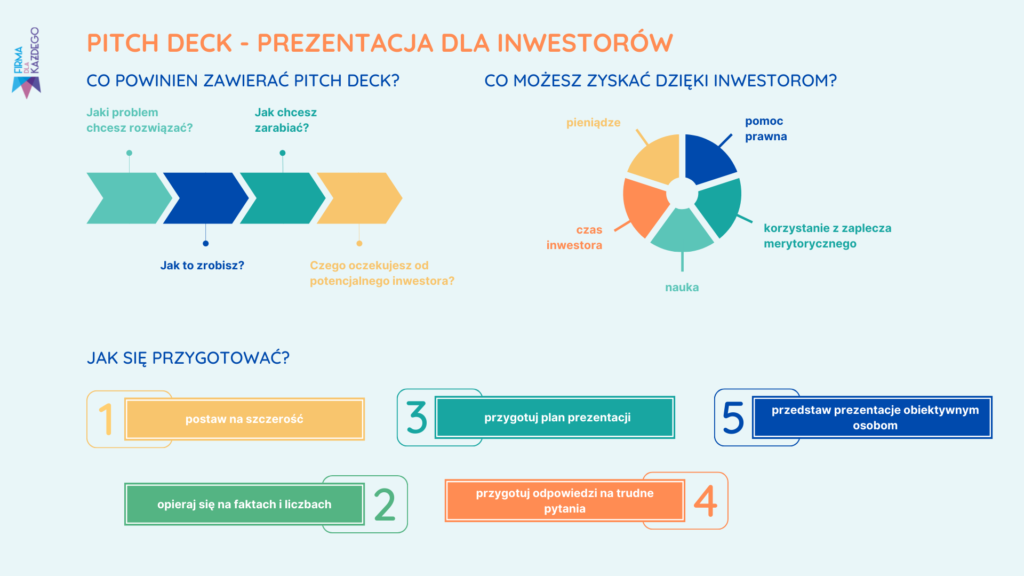
First and foremost, a pitch deck should answer a few basic questions:
- What problem are you trying to solve?
- How will you do it?
- How do you intend to make money?
- What do you expect from a potential investor?
Throughout the presentation, you should prioritise honesty, whilst also demonstrating determination, self-confidence and belief in your own plans, and base your argument on facts and figures. During a pitch deck, any figures backed up by research and facts come across very well. Your presentation to an investor should follow a clear plan. Prepare it as soon as possible and organise the individual points of your presentation according to this plan. Developing a good plan should be the foundation of your approach. Write down the individual sub-points of your pitch deck and how you will expand on them.

It’s better to have your own notes to hand than to suddenly forget what you were going to say next. During a pitch deck, it’s also worth preparing for difficult questions. So work out at least a few that spring to mind, so that you aren’t caught off guard. It’s worth bearing in mind that a potential investor may be viewing many such presentations. So make sure your pitch deck is your next ‘product’ – not just a dry presentation, but another means of solving a problem, just like your start-up. Try to present your pitch deck to at least a few impartial people. This will be one of the best lessons you can have before presenting to the actual investor.
In addition, pay attention to such important aspects of the presentation as your own appearance and the equipment you’ll use to display the slides. It’s worth checking in advance that there won’t be any problems playing them. The presentation should be simple, aesthetically pleasing and easy for the audience to follow. Your attire should be smart and appropriate for the venue where you will be presenting, as well as suiting you personally. Furthermore, adhering to the rules set by the investor – for example, limiting the presentation to 5 minutes – may be the first challenge you face. So try to follow all the guidelines; this will show respect for the people who are there to listen to you. Body language and tone of voice are very important, which is why it is best to practise your presentation several, a dozen or even several dozen times! Practise as many times as you need to!
What can you gain from an investor?
Money may seem like the obvious benefit, but it’s not always just about that. Securing funding obviously helps, but you can also gain intangible benefits, which are particularly vital when you’re just starting out. Young people often need guidance on the right path to take, which can be provided by slightly more experienced peers in the same field. This is precisely the case with investors – business angels, CEOs, experienced entrepreneurs or business incubators such as the ‘Firma Dla Każdego’ Foundation.

Investors who, in addition to their own funds, offer you their time, guidance, access to specialist resources or legal assistance are worth their weight in gold. Thanks to them, you’ll gain not only the necessary funds but also knowledge. Of course, such an investor will not devote their time to a project that does not interest them. You must do everything you can to ensure that the potential return on investment (whether in the form of money or their own time) presents an attractive prospect for them, from which they will benefit by choosing to work with you. So be open to non-financial proposals as well, and then you’ll be able to achieve even more!

Przedsiębiorca od prawie 20 lat. Związany m.in. z branżą inkubatorów przedsiębiorczości. Od ponad ośmiu zarządza Fundacją Firma Dla Każdego, która prowadzi jeden z największych inkubatorów w Polsce. Specjalizuje się w zagadnieniach prowadzenia i rozwoju biznesu, legalizacji pobytu i pracy, a także aspektami podatkowymi prowadzenia firmy.
Want to start a business without the paperwork?
Get in touch — we will help you choose the best way to run your business.
Get in touch