WHAT IS A START-UP?
16/04/2022
What is a start-up?
The search for the dream job in the labour market is often brought back down to earth by current trends, unsatisfactory pay or unacceptable working conditions. Unfortunately, there is still a fairly widespread stereotype in our society that a full-time job is the best option, whilst setting up your own business (a start-up) involves a great deal of uncertainty and risk.
Of course, there are certain risks involved in starting your own business, but the benefits far outweigh them. It is therefore worth encouraging young people in particular to seek their own path in business, and should they face setbacks, the job market will always remain open to them. The idea is to set up a start-up that will allow them to test various approaches and successfully find the right path through the intricacies of business. Your start-up will certainly bring you a great deal of satisfaction and essential experience.
What characterises a start-up?
A start-up is a type of business that lacks a clearly defined scope of activity. It is generally accepted that it is a specific type of enterprise that allows you to explore and define your own business model, enabling you to achieve the best possible results. Start-ups are defined in many different ways, but they most often operate in sectors such as new technologies, communications, IT and high-tech. They usually operate for a relatively short period – a maximum of 5–8 years. They are characterised by innovation, scalability and greater risk for the entrepreneur; however, if successful, they also enable higher profits to be achieved quickly. Start-ups are most often funded from the founders’ own resources or financed by funds raised from sponsors or so-called business angels. They are also supported by, for example, academic business incubators, which oversee the successful development of new ventures.
Why is it worth setting up your own business as early as possible?
Getting to grips with business as early as possible is a good way to gain the necessary experience and develop more quickly. There are several undeniable advantages to start-ups that make this type of business worth pursuing.
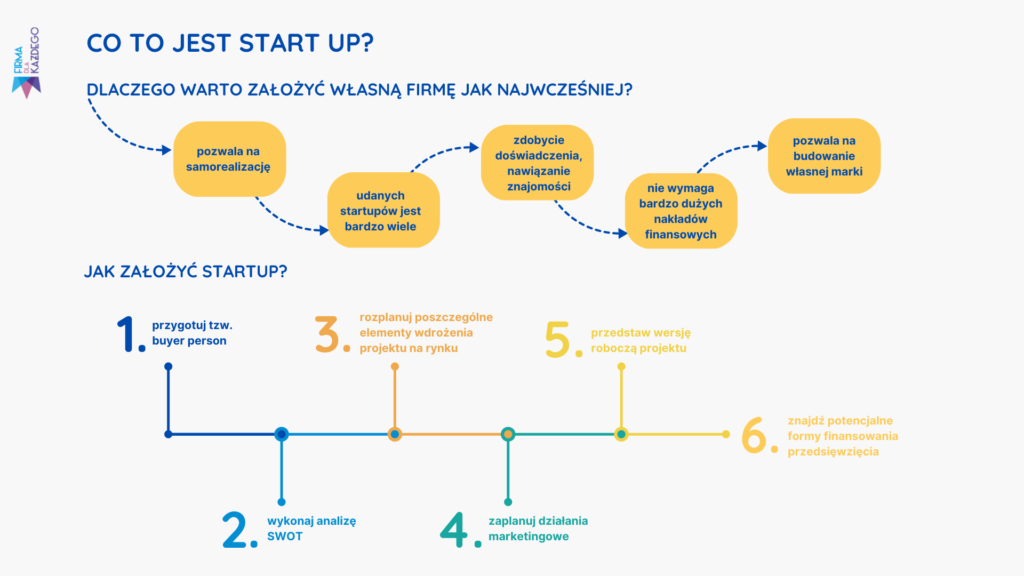
- Firstly, a start-up does not require a huge financial outlay. Far more important than the funds you have is a good idea, the ability to present yourself effectively, and knowing where to look for investors, sponsors and potential partners. To this end, it is worth honing your skills in sales, self-presentation, communication and body language – these are very useful skills. If you manage to secure the necessary funding, a start-up will not be as risky as it seems. Any potential losses in the form of costs will not be significant, but the knowledge and skills gained are priceless.
- There are many examples of successful start-ups. The fact that others have succeeded can be a good incentive to take action. Among the best-known are Snapchat, Airbnb, Netflix and Uber. The foundation of a good start-up lies in identifying users’ needs and devising a way to meet them.
- A start-up allows you to build your own brand. You are both the helmsman and the ship of this venture. So you don’t have to do anything against your better judgement. Instead, keep learning and trust your own intuition, which will lead to success.
- Furthermore, your start-up will allow you to gain experience, make connections and learn – both from your successes and your failures
- It will allow you to achieve self-fulfilment, which for many people is the most important benefit of running your own business.

How do you set one up?
Unfortunately, a vision of a successful business alone is not enough. If you’re wondering how to set up a start-up that stands a chance of success – prepare thoroughly and work through a few key points. First and foremost, it’s worth clearly defining your target audience. To this end, you can draw up a profile of the ideal buyer of your product or service – the so-called ‘buyer persona’. It is worth specifying the gender, age, education, income, hobbies, leisure activities and consumer behaviour of such people. Next, you should research the market environment, including, for example, carrying out a SWOT analysis, mapping out the various stages of launching the project on the market, planning marketing activities, presenting a draft version of the project and, finally, identifying potential sources of funding for the venture. Some of these tasks can be very challenging, so it is worth seeking out organisations that can help turn these plans into reality.
Support for young entrepreneurs
Academic business incubators are organisations that are keen to help current students and university graduates set up their own businesses, for example in the form of a start-up. Incubators enable start-up founders to secure the necessary funding or to be introduced to the world of business. One example of a very dynamic business incubator is the ‘Firma dla Każdego’ Foundation. With this sort of support, it will certainly be easier to take the decision to strike out on your own in the labour market and in business.

Przedsiębiorca od prawie 20 lat. Związany m.in. z branżą inkubatorów przedsiębiorczości. Od ponad ośmiu zarządza Fundacją Firma Dla Każdego, która prowadzi jeden z największych inkubatorów w Polsce. Specjalizuje się w zagadnieniach prowadzenia i rozwoju biznesu, legalizacji pobytu i pracy, a także aspektami podatkowymi prowadzenia firmy.
Want to start a business without the paperwork?
Get in touch — we will help you choose the best way to run your business.
Get in touch