How do you set up a business whilst working as an employee?
06/06/2024
In this article, we answer the question: ‘Can someone in full-time employment set up a business?’, covering all the related issues. Read on to find out how to set up your own business whilst working full-time!
Can someone in full-time employment set up a business? Setting up a business whilst in full-time employment
Search engines frequently receive queries such as: “I’m in full-time employment and want to set up a business” and “Can I set up a business whilst working?”. The second search term and the question behind it are entirely valid and certainly indicate a certain level of maturity on the part of someone interested in starting their own business.
First and foremost, however, it must be noted that, as a general rule, there are no legal provisions prohibiting the combination of full-time employment with running one’s own business. Setting up a business whilst in employment is therefore entirely possible. It is important, however, to bear in mind certain specific conditions that will allow you to maintain good and secure relations not only with your current employer, but also with the tax office and the Office of Competition and Consumer Protection.
What are these conditions?
‘I’m in full-time employment and want to set up a business’ – what you need to bear in mind when setting up a business whilst working under an employment contract (how to set up a business whilst in full-time employment?)
Firstly, although, as a general rule, you are not obliged to inform your current employer that you are setting up a business, such an obligation does arise if, as part of your business activities, you settle your taxes under the general rules (i.e. according to the tax scale).
However, even if you choose a different form of taxation, it is worth letting your employer know about your plan to set up your own business. Why?
This is because some employees have signed non-competition agreements. Even if you have not signed such an agreement, your duties as an employee still include, amongst other things, looking after the interests of your employer, protecting its property and keeping confidential any information whose disclosure could expose your employer to harm (these obligations arise directly from point 4 of paragraph 2 of Article 100 of the Act of 26 June 1974 – Labour Code (consolidated text: Journal of Laws of 2023, item 1465)).
This means that you cannot run your own business at the expense of your full-time employment. You are, in fact, obliged to look after the interests of the employer with whom you are employed. You should therefore not undertake any activities that could potentially have a negative impact on the employer (e.g. carrying out your business activities during your full-time working hours or poaching customers from the employer).
Such risks, however, are obvious if the business you set up is of a similar (or – worse still – identical) nature to that of the company where you are employed.
It is therefore best to tell your employer directly about your plans to set up your own business, explaining the nature and scope of the business you intend to run. Such a discussion will help minimise any potential risk of breaching the provisions mentioned above and other relevant regulations.
The situation will be slightly different if the organisation where you are employed under an employment contract is a public administration body. In this case, such a discussion is not merely optional, but simply mandatory. If you are in full-time employment with a public administration body, you require that body’s consent to set up your own business. You can obtain this by asking your line manager.
Full-time employment plus self-employment: taxes and tax returns (i.e. the cost of running a business whilst in full-time employment)
Every employee hired under an employment contract is subject to two tax rates: 12 per cent and 32 per cent.
Entrepreneurs, on the other hand, in addition to the tax scale, can also choose between a flat-rate tax and a lump-sum tax on recorded income.
Opting for the flat-rate scheme or the flat tax means that, once the tax year has ended, you will need to submit two PIT returns. In such cases, income from self-employment cannot simply be added together with that earned from full-time employment (as they will be taxed differently).
However, when considering the choice of taxation method, it is worth emphasising very clearly that the lump-sum scheme, or the flat-rate tax is not available to those who provide services, or plan to provide services, to a former or current employer, where such services fall within the scope of those performed under an employment contract signed with that employer. Such individuals are therefore obliged to choose the tax scale. The grace period for these rules is one year in the case of the flat-rate tax, and as long as two years in the case of the lump-sum tax.
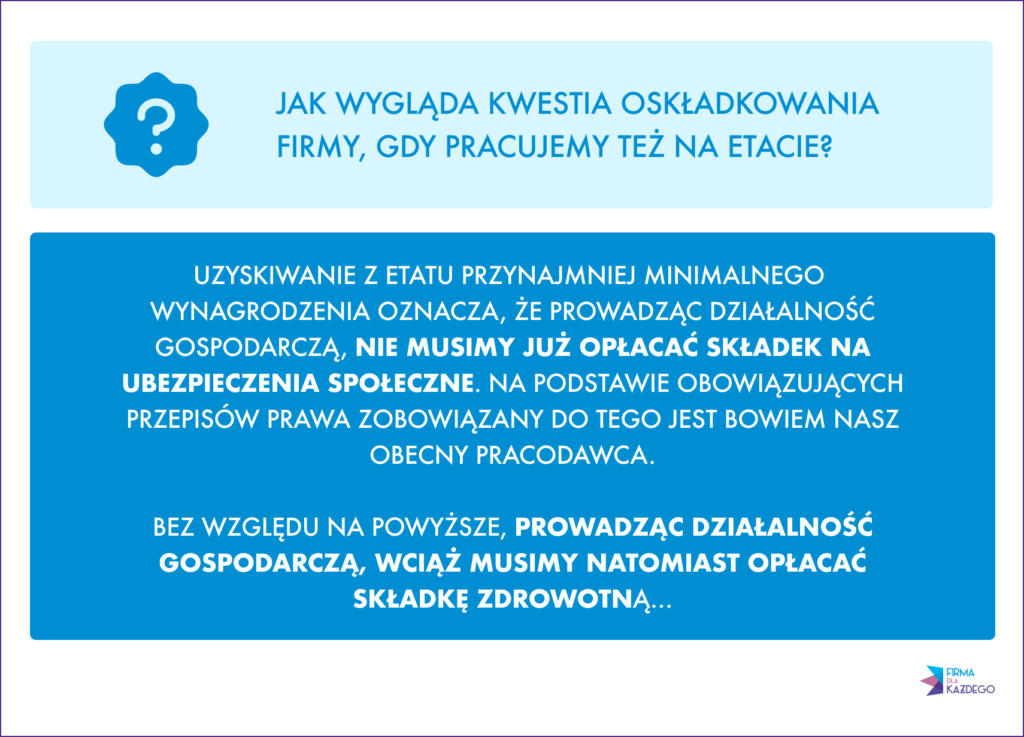
HOW DOES THE ISSUE OF SOCIAL SECURITY CONTRIBUTIONS FOR A BUSINESS WORK WHEN WE ALSO HAVE A FIXED-TERM JOB?
Earning at least the minimum wage from full-time employment means that, whilst running a business, we are no longer required to pay social security contributions. Under current legislation, this obligation falls to our current employer.
Regardless of the above, whilst running a business, we are still required to pay health insurance contributions…
Setting up a business whilst on an employment contract? Or perhaps you’d prefer to use a business incubator instead?
Are you in employment and want to set up a business? A business incubator could be the solution for you!
A business incubator is an organisation that lends its legal status to people who have a business idea but do not wish to set up their own sole trader business for that purpose. It’s the cheapest, quickest and least risky way to set up your own business – even whilst in full-time employment.
The highest-rated business incubator in Poland is the ‘Firma Dla Każdego’ Foundation.
The ‘Firma Dla Każdego’ Foundation is an organisation that supports entrepreneurship amongst Poles and foreign nationals, and will help you fulfil your business dreams!
Interested? Check out the details of our offer on our website: https://firmadlakazdego.pl/.
Sources:
- https://www.youtube.com/watch?v=-c2clXtiaH8
- https://www.youtube.com/watch?v=PM4LI4qT1SE
- https://poradnikprzedsiebiorcy.pl/-czy-wiesz-ze-praca-na-etacie-nie-wyklucza-prowadzenia-dzialalnosci
- Act of 26 June 1974 – Labour Code (consolidated text: Journal of Laws of 2023, item 1465)
- Act of 26 July 1991 on Personal Income Tax (consolidated text: Journal of Laws of 2024, item 226, as subsequently amended)
- https://firmadlakazdego.pl/czym-jest-inkubator-przedsiebiorczosci/
- https://firmadlakazdego.pl/firma-bez-zus-w-polsce/
- https://firmadlakazdego.pl/

Przedsiębiorca od prawie 20 lat. Związany m.in. z branżą inkubatorów przedsiębiorczości. Od ponad ośmiu zarządza Fundacją Firma Dla Każdego, która prowadzi jeden z największych inkubatorów w Polsce. Specjalizuje się w zagadnieniach prowadzenia i rozwoju biznesu, legalizacji pobytu i pracy, a także aspektami podatkowymi prowadzenia firmy.
Want to start a business without the paperwork?
Get in touch — we will help you choose the best way to run your business.
Get in touch