CERTIFICATE OF TAX RESIDENCE
29/11/2022
Tax residence – what is it?
Removing the requirement for foreign nationals to hold tax residence certificates would reduce the costs of employing them on a contract-for-services basis. Currently, the client must deduct as much as 20 per cent tax from the remuneration of individuals from another country,
who do not hold a tax residence certificate. In the event of hostilities, obtaining such a certificate may be exceptionally difficult.
In this article, you will learn:
- What is the link between a tax residence certificate and a double taxation agreement?
- What are the rules for taxing a foreigner’s income?
- What are the employer’s obligations?
- How does the certificate affect the employment of foreign nationals in Poland and their remuneration?
Who is eligible to receive a tax residence certificate?
A Polish tax resident is a person who:
- has the centre of their personal or business interests in Poland, or
- stays in the Republic of Poland for more than 183 days during a tax (calendar) year.
If a foreign national meets one of the above conditions, all their income is taxed in accordance with Polish law. The location of the sources of that income is irrelevant.
Under an international double taxation agreement, income is taxable only in the country of residence. To benefit from the double taxation agreement, a tax residence certificate is required. If the employee in question does not have one, the employer is obliged to deduct a 20 per cent flat-rate PIT tax.
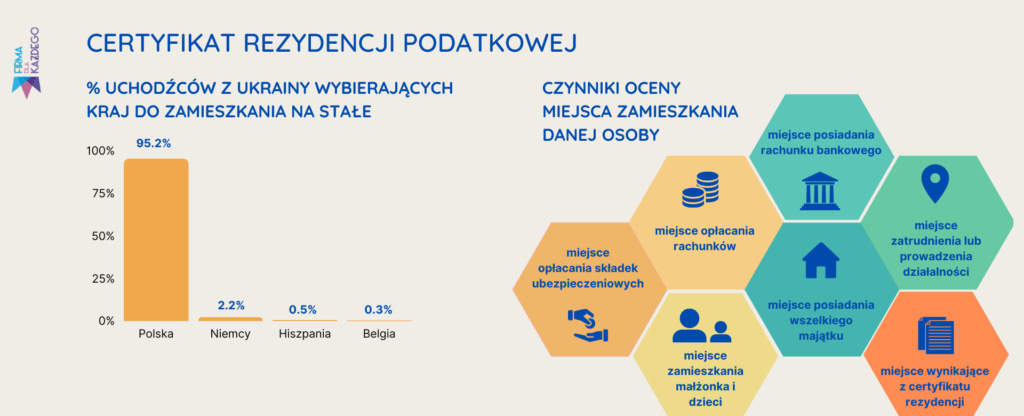
Taxation rules for foreign nationals
These are explained in detail in Article 29 of the PIT Act. It states that the income of foreign nationals is subject to a 20 per cent flat-rate income tax. The only way to avoid paying such a high tax is to hold a tax residence certificate.
Lack of a tax residence certificate and the employer’s obligations
In the absence of such a certificate, the Polish employer has further obligations. They must also transfer the amount of the flat-rate tax by the 20th day of the month following the month in which the tax was collected to the account of the tax office through which the head of the tax office competent for the taxpayer’s place of residence carries out their duties.
The employer is also obliged, by the end of January of the year following the tax year, to submit annual PIT-8AR returns to the tax office with jurisdiction over the employer’s registered office.

Tax residence certificate and the amount of a foreign national’s remuneration
If a tax residence certificate is presented, a person from another country pays tax exclusively at their place of residence. In that case, the Polish employer will not be obliged to withhold a flat-rate tax of 20 per cent. However, the double taxation agreement does not exempt the employer from the obligation to submit the personalised IFT-1R form to the contractor and the tax office responsible for the taxation of foreign nationals by the end of February of the following year.
The above clearly shows that employing foreign nationals in Poland who hold tax residence certificates is far less complicated.
If you need help obtaining a tax residence certificate – please contact us!

Przedsiębiorca od prawie 20 lat. Związany m.in. z branżą inkubatorów przedsiębiorczości. Od ponad ośmiu zarządza Fundacją Firma Dla Każdego, która prowadzi jeden z największych inkubatorów w Polsce. Specjalizuje się w zagadnieniach prowadzenia i rozwoju biznesu, legalizacji pobytu i pracy, a także aspektami podatkowymi prowadzenia firmy.
Want to start a business without the paperwork?
Get in touch — we will help you choose the best way to run your business.
Get in touch