Tax relief for young people in 2026 – who is eligible and what is the limit?
03/03/2026
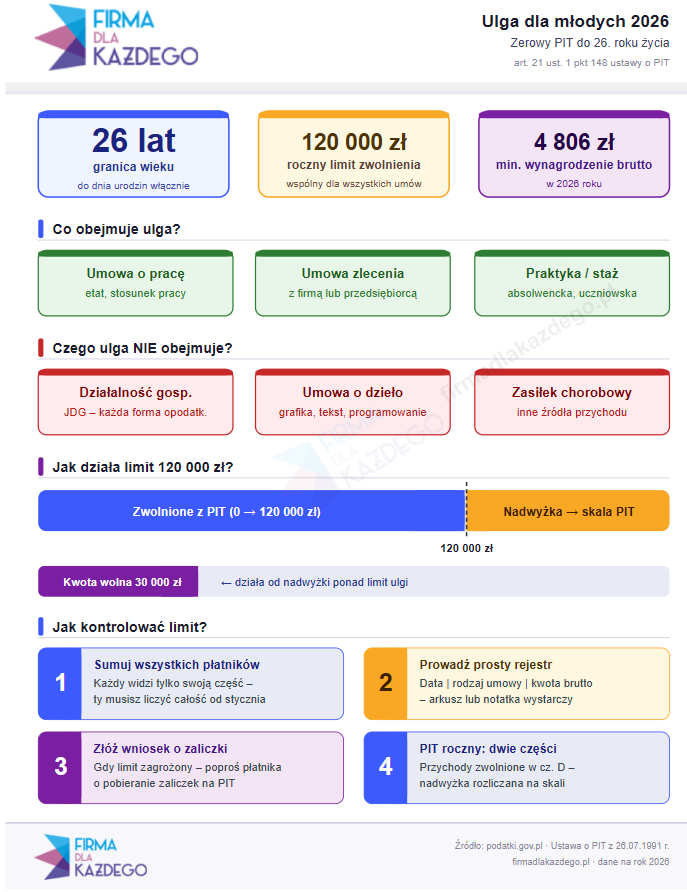
The minimum wage in 2026 is 4,806 zł, and the limit for the tax relief for young people remains at 120,000 zł. In 2026, the youth tax relief exempts people under the age of 26 from paying personal income tax (PIT) within the annual limit on income covered by the relief.
Once the limit is exceeded, the excess is taxed according to the standard tax scale. The relief does not apply to sole traders, contracts for specific work or sickness benefit.
The youth tax relief in 2026: what does zero PIT up to the age of 26 entail?
The tax relief for young people in 2026 does not mean a complete exemption from all taxes, but rather an exemption from personal income tax on selected types of income. A person under the age of 26 is eligible for the relief up to and including their birthday. It is therefore the specific moment of reaching the age limit that counts, rather than the year of birth itself.
The legal basis for this is Article 21(1)(148) of the Personal Income Tax Act of 26 July 1991. The exemption applies to income from specific sources, not to any funds received into an account. A young person may work in a permanent role, on a contract basis or on a graduate placement and still benefit from these preferential arrangements, but this mechanism does not apply to every form of income.
This scheme has a very specific aim. It is intended to make entering the labour market more attractive and to increase take-home pay at the start of a professional career. The difference is particularly noticeable when someone starts with an employment contract or several contract jobs at the same time, as the advance PIT payment does not reduce their monthly pay. Social security contributions may still be deducted, so the relief does not remove the entire burden of social security contributions.
Future of Jobs Report 2025
“Analytical thinking remains the most sought-after skill amongst employers, with seven out of ten companies considering it essential.”
World Economic Forum, 2025
This clearly illustrates the rationale behind this scheme. Young employees find it easier to get off to a good financial start when the market expects them to quickly become self-reliant and gain experience. The tax relief for young people in 2026 therefore acts as a buffer at the start of their careers, but only within the framework of statutory sources of income.
The 120,000 zł limit in 2026, when the exemption ends and tax becomes payable
PLN 120,000 is the annual limit on income covered by the relief and the common threshold for all employers and all contracts falling within the scope of the exemption. If someone works for two employers at the same time or takes on several freelance assignments, each employer only sees their own share of the pay. They cannot see the taxpayer’s total earnings, so it is easy to end up in a situation where individual payments appear to be within the limit, whilst the total has long since exceeded the threshold.
The total income is more important than any single contract. Exceeding the limit does not mean losing the tax relief from the very first zloty above the threshold for the whole year; rather, the excess is taxed according to the tax scale. It is only this portion that ceases to benefit from the tax relief. The tax-free allowance itself still applies and stands at 30,000 zł, so even after the relief limit has been exceeded, not all additional income is immediately subject to tax.
For someone earning a regular income throughout the year, the limit is often reached sooner than one might think. With several sources of income, all it takes is a change to the work schedule or a quarterly bonus, and the limit disappears from view much sooner than planned. In such cases, the advance payments deducted by the payroll agent may prove insufficient, and an additional payment will be due in the annual tax return.
PLN 120,000 is the combined limit for tax reliefs falling under the same threshold.
From a financial planning perspective, there is one further restriction to bear in mind. The limit is not automatically adjusted for inflation, so as salaries rise, an increasing number of people may reach it sooner than they would have a few years earlier. The tax relief for young people in 2026 still provides a significant net benefit, but only until the income threshold for the relief is exceeded.
Permanent employment, contract work, graduate work placement – what types of income does the youth tax relief cover?
Employment contracts, contract-for-service agreements, graduate work placements and school work experience programmes differ in terms of social security contributions, but they all have one thing in common – the absence of a PIT advance payment increases the net pay. For permanent employment, social security and health insurance contributions usually remain in force, so the pay increases mainly because the tax office does not collect monthly advance payments until the limit is exceeded.
A contractor may also benefit from a PIT exemption if the contract has been concluded with a company or sole trader and falls within the statutory list. Here, there is an important exception concerning students and pupils up to a certain age and educational status. Provided the conditions are met, they can avoid paying both PIT and ZUS contributions on such work. This is one of the most favourable arrangements for those earning extra income whilst studying.
Employment statuses of young workers
“Childless people and parents of children who have already reached the age of majority contribute almost 60 per cent of PIT tax to the state budget.”
Ministry of Finance, 2025
This figure highlights another point – the tax system relies heavily on economically active individuals without family dependants or those who have passed the age limit for youth tax relief. The most important distinction remains that between gross and net earnings. The relief itself cancels out the PIT advance payment, but social security contributions may still reduce take-home pay depending on the type of contract.
When someone has several sources of income at once – a full-time job in the morning and two small freelance assignments in the evening – they must add up all income covered by the relief. Here is a simple example. Three smaller contracts worth a few thousand zlotys each per year can result in a much higher total than a single stable, average-sized salary. It is the total income that determines the limit, not the number of contracts signed.
Self-employment, contract-for-work and sick pay: when does the youth tax relief not apply?
Self-employment falls outside the scope of the relief regardless of the form of taxation. The tax scale, flat-rate tax or lump-sum tax do not change anything here. A person running a sole trader business may be under 26, but the business’s income is still excluded from this exemption. The same applies to working arrangements resembling freelance work without a permanent contract, as the nature of the arrangement alone does not entitle the individual to a zero PIT rate.
In the case of a sole trader, it is the source of income that counts, not the entrepreneur’s age. A young person may claim expenses, pay contributions and choose their form of taxation, but they will not benefit from the youth tax relief simply because they are just starting their business. If someone combines a full-time job with their own business, the exemption will only cover income from an employment contract or a contract for specific work, provided it falls within the limit of PLN 120,000 per year. Income from invoices issued as part of a sole trader business must be accounted for under the standard rules.
Contracts for specific work are just as clear-cut. Even a short graphic design, copywriting or programming project for a gross fee falls outside the scope of the relief. This comes as a surprise to many novice contractors, as they intuitively treat any casual work as similar to a contract of mandate. However, the law looks at the nature of the payment, not merely the fact that the individual is earning extra income before reaching the age of twenty-six.
The exclusion also applies to business management agreements, management contracts and similar arrangements. In such cases, the payer does not apply the zero PIT rate, even if the person performing the contract is very young and works exclusively for a single entity. This is important when negotiating your first contracts after university, as the difference between a contract for services and a contract for specific work can determine whether a PIT advance payment is required straight away. Mere similarity to ‘self-employment’ is not sufficient.
Sick pay is also not exempt from tax. It is treated as income from other sources and is taxable under general rules. So if a young person worked in a tax-free salaried role for part of the year and later received sickness benefit, two different tax regimes will appear on their annual tax return. It is precisely this aspect that most often confuses people who see only the absence of a tax deduction on their payslip and assume that all benefits are fully tax-exempt.
Some types of income are excluded from the tax relief even if the taxpayer is under 26. This applies, amongst other things, to self-employment, contracts for specific work and sickness benefit.
If you want to check your own situation without the risk of making a mistake, it is best to start with the name of the form or the basis for payment stated in the contract. A contract of mandate concluded with a company may qualify for the relief, but a contract for specific work does not. A sole trader (JDG) never qualifies for the relief, even if the monthly turnover is low and the business is carried out on a secondary basis. In the case of sickness benefits, it is also important to bear in mind that the source of the payment changes the rules for tax settlement, and the automatic assumption of a zero PIT liability no longer applies.
Section 21(1)(148) of the PIT Act
“Income from a service relationship, an employment relationship, outwork and a cooperative employment relationship, as well as from graduate work placements and school work experience placements, and from contracts for specific tasks, is exempt from income tax”
The Act of 26 July 1991 on Personal Income Tax
For people aged 26 or under, the safest rule is simple – if the income falls outside this list, the relief does not apply. If you run your own business, you must therefore consider costs and the tax rate separately; if you receive sickness or disability benefits, you must apply the standard PIT rules from the very first zloty of taxable benefit.
How can you keep track of the limit yourself when you have several contracts and payers?
With several sources of income, it’s all too easy to miss the point at which the exemption ends. Each payer can only see their own portion of your payments, so they don’t have a complete picture of how much you’ve earned since the start of the year. This means that if you’re in full-time employment and on a contract with two different employers, the total may exceed the limit more quickly than a single monthly salary would suggest.
The safest approach is to keep a simple record of all income covered by the tax relief. All you need is a note on your phone or a spreadsheet with three columns, where you enter the payment date, the type of contract and the gross amount. This record allows you to see straight away whether you’re approaching the PLN 120,000 limit, rather than only finding out once you’ve received information from the HR department. It’s also a good idea to break down your income by payer, as it’s the number of payers that most often confuses people working simultaneously under several contracts.
With regular payments, it’s easy to calculate the rate at which your income is accumulating. If you receive a similar amount each month, simply multiply it by the number of months worked and compare the result with the limit. When rates vary, it’s better to look at the total since January rather than at any single month. A single higher bonus or a few extra assignments during the summer holidays can bring your tax settlement forward by a few weeks.
You can also decide on an ongoing basis whether you want to continue claiming the tax relief from all your payers, or whether you’d prefer to ask one of them to deduct tax at source in advance. This move can be sensible if you already know that the annual threshold will be exceeded and you do not want to face a large additional payment in your annual tax return. It is not a question of giving up the tax relief, but of spreading the tax burden over several months rather than facing a one-off hit at the end of the year.
The PLN 120,000 limit applies collectively to all contracts covered by the relief, so you must monitor your tax situation throughout the entire tax year. If you have two full-time jobs or a full-time job and a contract of mandate, each subsequent payment should be included in a single statement. This gives you real control over the situation and helps you avoid a tax return based solely on estimates.
When is it worth applying to receive advance payments without the relief?
Opting out of the relief during the year does not mean you lose your entitlement to the relief. It is a way of keeping your tax returns in order when there is a high risk of exceeding the limit, or when you have several sources of income and do not want to have to pay additional tax in a single lump sum later on. Such an application is submitted to the tax withholder, who will then start deducting advance tax payments from the month following receipt of the application at the latest.
This option is most commonly chosen by people working for several employers at the same time or combining a full-time job with seasonal contract work. In such situations, the exemption applies automatically only if you remain within the limit and there is no risk of exceeding it. If your total income starts to rise faster than you anticipated, the absence of advance payments may mean you have to pay a larger additional sum at the end of the year.
This arrangement can also be helpful for those who wish to avoid discrepancies between their current pay and their annual tax return. Instead of receiving higher net pay for a few months and then having to pay back part of the tax via your PIT return, you can have advance payments deducted from any excess straight away. This arrangement makes for a more predictable household budget, especially when income is irregular and it is difficult to estimate the final total annual income.
There are also situations where it is better to leave the allowance unchanged until the end of the year. If you are working under just one contract and it is clear that you will not approach the PLN 120,000 limit, having advance payments deducted would place an unnecessary strain on your cash flow during the year. In such cases, the exemption usually works best – your net pay is higher straight away and you do not have to wait for a tax refund after your tax return has been processed.
Provided the declaration meets all the requirements regarding its content, the payer will withhold tax without applying the exemption from the month following the submission of the declaration at the latest.
The following month is the practical deadline for the payer after receiving a correct application. This allows a decision to be made before the end of the tax year, thereby reducing the risk of having to make an additional payment without waiting for the annual tax return.
How can you settle the excess without any hassle in your annual PIT return?
When the limit is exceeded, the full benefit of the relief is not lost. Part of the income up to the statutory limit is exempt, and only the excess is subject to tax. The standard tax scale rules and the tax-free allowance of 30,000 zł can be applied to this surplus, so tax is not automatically levied from the very first złoty above the limit.
In your annual tax return, you must declare both the income covered by the relief and the portion of income that is already subject to tax. The most important thing is to keep the exempt and taxable amounts separate, as incorrectly entering the entire sum as income may artificially inflate the amount owed to the tax office. If you have several contracts, it is a good idea to compare the PIT-11 form from each payer with your own breakdown of monthly income.
Tax-deductible expenses are calculated only on the taxable portion. If, after exceeding the limit, you still have costs relating to your employment or other income subject to the tax scale, these can only reduce the tax base down to the amount of that taxable portion. They cannot be carried forward beyond the income nor used to reduce the tax-free amount.
For someone employed throughout the year, the order in which the figures are calculated on the form is also important. First, you separate the exempt income from the taxable income; then you check the expenses; and only at the end do you calculate the tax liability after taking the tax-free allowance into account. This order helps to avoid a situation where the tax office sees only the surplus without the context of your full-year income.
Section 21(1)(148) of the PIT Act
“Income received by a taxpayer until they reach the age of 26 is exempt from income tax (…)”
The Personal Income Tax Act of 26 July 1991
Any amount exceeding the limit is subject to standard taxation according to the tax scale, but the relief itself continues to shield part of the earnings from personal income tax. For many people, this means a one-off additional payment rather than a fixed tax liability throughout the year.
Frequently asked questions
If you exceed 120,000 zł, can you still benefit from the 30,000 zł tax-free allowance?
Yes, but only up to the amount of income taxed according to the tax scale. Once the PLN 120,000 threshold is exceeded, the excess is subject to the tax scale, where the tax-free allowance of PLN 30,000 applies. If your total income does not exceed this threshold, your tax liability may still be zero.
From when does the payer stop applying the relief if I submit an application to have advance tax deductions made without the tax-free allowance?
Once the declaration has been submitted, the payer will deduct advance tax payments without the exemption from the following month at the latest. This reduces the risk of having to pay additional tax if you have several contracts or your income increases during the year.
Where should income covered by the relief be declared in the annual PIT-37 or PIT-36 tax return?
Exempt income is entered in the section of the tax return relating to tax-exempt income. In the PIT-37 form, this is Section D, and in the PIT-36 form, it is also Section D. This allows the tax office to see which part of your income was not subject to tax.
Can the tax relief for young people be combined with the child tax relief and the joint tax return for married couples?
Yes, these reliefs can be claimed simultaneously, provided the other statutory conditions are met. With the child tax relief, an additional refund is also possible, up to the amount of social security and health insurance contributions paid on income covered by the youth tax relief. This provides a real benefit to those who are entitled to several deductions at the same time.
Do you need to file a PIT return if all your income is covered by the relief and you have no other income?
No, simply receiving income that is exempt from tax does not in itself create an obligation to file a tax return. The obligation arises if there is other taxable income, if the threshold is exceeded, or if you wish to claim a refund of overpaid tax. If you have no other sources of income, filing a tax return is often unnecessary.
How do tax-deductible expenses work if part of your earnings exceeds the tax relief limit?
You can only claim tax-deductible expenses against the part of your income that is subject to tax. You cannot deduct more than the amount of the taxable surplus, so only the portion exceeding 120,000 zł is taken into account when filing your tax return. This means that costs do not reduce income that is exempt from the allowance.
Sources:
-
- https://www.podatki.gov.pl/ulgi-i-odliczenia/ulga-dla-mlodych-pit/
- https://www.gov.pl/web/kis/kas-przypomina-zasady-rocznego-rozliczenia-pit-osob-do-26-roku-zycia

Przedsiębiorca od prawie 20 lat. Związany m.in. z branżą inkubatorów przedsiębiorczości. Od ponad ośmiu zarządza Fundacją Firma Dla Każdego, która prowadzi jeden z największych inkubatorów w Polsce. Specjalizuje się w zagadnieniach prowadzenia i rozwoju biznesu, legalizacji pobytu i pracy, a także aspektami podatkowymi prowadzenia firmy.
Want to start a business without the paperwork?
Get in touch — we will help you choose the best way to run your business.
Get in touch