SELF-EMPLOYMENT – PROS AND CONS
21/05/2022
Self-employment – definition
Self-employment is a dream for many people who do not want to spend their whole lives working solely in full-time employment. Young people often have no choice but to start their careers in full-time employment or working for a company (if only because of their studies and the necessary work placements). After this stage, some of them are happy to continue in employment, which means they remain in full-time jobs. Over time, getting used to a stable situation begins to
take precedence over their aspirations. It becomes increasingly difficult to opt for the uncertainty that comes with being an employee. Working for oneself can be stressful, but it is also extremely rewarding. Setting up a business can bring a great deal of satisfaction and even better earnings than many companies offer. Self-employment is a path often chosen by programmers, graphic designers, copywriters and other freelancers. In this case, working hours and salary ranges are practically non-existent. What are the main pros and cons of self-employment?
What does self-employment involve?
Self-employment is a form of business where the founder works independently (without a boss or staff). It is usually a one-person business in which the owner acts as both the service provider and the sales representative, accountant or marketer. People who provide services independently often opt for this form of employment. These include, for example, artists, copywriters, translators, graphic designers, programmers and designers. Their work is based on the completion of a specific project, rather than repetitive work for a set number of hours. This is precisely why the self-employment model has been specifically designed with freelancers in mind.Self-employment allows them to set up a fully-fledged business and settle accounts with clients, but it also entails certain obligations. These include, for example, compulsory social security contributions (ZUS) and advance payments towards personal income tax (PIT).
Setting up a business also involves registration with the CEIDG, the need to document income and keep accounts. However, you do not need to set up a business straight away in order to give up a full-time job. To this end, you can establish a partnership with a business incubator, such as the ‘Firma Dla Każdego’ Foundation, and acquire legal personality. Thanks to this solution, the costs of earning an income are significantly lower. The Foundation fully handles all financial settlements with clients. A start-up that is gaining momentum also becomes a more credible business partner for a wider range of organisations. Given these facts, it is worth considering working with a business incubator, not just at the start of your business journey. It is a good way to reduce costs, which can be overwhelming for most self-employed people.

The benefits of self-employment
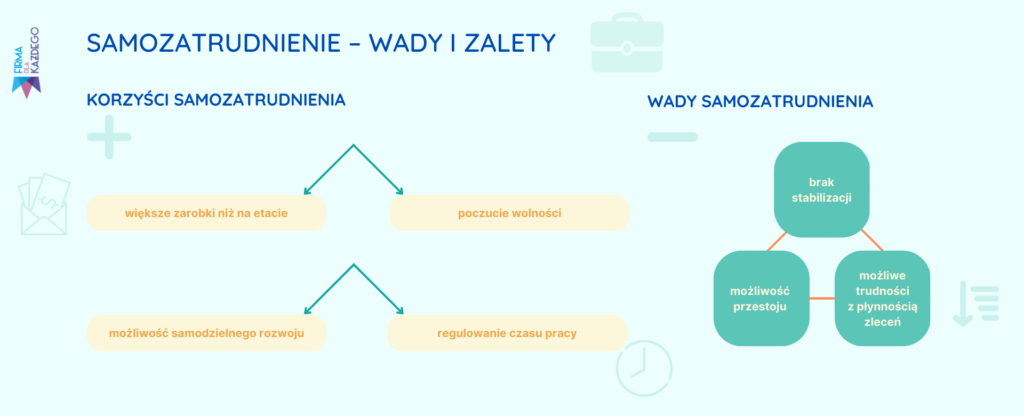
Self-employment brings with it, above all, two major advantages. Firstly, earnings are often significantly higher than those earned in full-time employment. This is because all the revenue the business generates is, at the same time, the freelancer’s income. Of course, they bear the costs of running the business, but the income that remains after these costs are covered is not shared with anyone else. Such a person can therefore set their own rates and remuneration for their work. Secondly, self-employment offers freedom. The feeling of being your own boss is very appealing and, at the same time, allows for greater freedom. A self-employed person decides for themselves how much they work each day – though this does not mean there is less work to do. Setting up your own business brings immense joy and is a source of satisfaction for virtually every entrepreneur. Self-employment allows you to realise your dreams and often to combine your interests with your work.
What are the drawbacks of self-employment?
Unfortunately, self-employment also has its downsides. One of them is a lack of stability. This manifests itself in fluctuating income from month to month or even the possibility of periods of inactivity. But is a full-time employee completely free from such issues? Even large state-owned companies experience difficult periods. A new business may struggle to maintain a steady flow of work, but these problems may ease over time. There may be fewer jobs, but they may be better paid, or there may be a large number of smaller clients. It also often seems that self-employment is a veritable idyll. Setting your own hours, having no boss, the opportunity for personal development – all of that is true. However, a huge amount of work is often required at the outset. When self-employed, an entrepreneur often has to fulfil many roles at once. They are an accountant, a service provider, a marketer and a salesperson all in one. Particularly at the start, they must either raise the funds to run the business themselves or make use of a business incubator.

Self-employment has both its pros and cons. It is worth considering this form of work, particularly if you have a flair for business, are enterprising and are not afraid of challenges. Self-employment is an adventure that can also bring very good earnings and a great deal of satisfaction.
See also: How to set up a business?

Przedsiębiorca od prawie 20 lat. Związany m.in. z branżą inkubatorów przedsiębiorczości. Od ponad ośmiu zarządza Fundacją Firma Dla Każdego, która prowadzi jeden z największych inkubatorów w Polsce. Specjalizuje się w zagadnieniach prowadzenia i rozwoju biznesu, legalizacji pobytu i pracy, a także aspektami podatkowymi prowadzenia firmy.
Want to start a business without the paperwork?
Get in touch — we will help you choose the best way to run your business.
Get in touch