REGULARISATION OF RESIDENCE FOR RUSSIANS
11/10/2022
Mobilisation in Russia, and working in Poland
Mobilisation is underway in Russia in connection with the military operations in Ukraine. Not every Russian citizen wants to take part in it. That is why some people are trying to leave the country and start a new life elsewhere.
National or Schengen visas could help them do this. However, Poland, Lithuania and Latvia have decided to close their borders to Russian citizens. Nevertheless, the legalisation of residence for Russians remains an open issue.
In this article, you will learn:
- Can a Russian national apply for a humanitarian visa in Lithuania and Latvia?
- What is the situation following the closure of the borders with Russia?
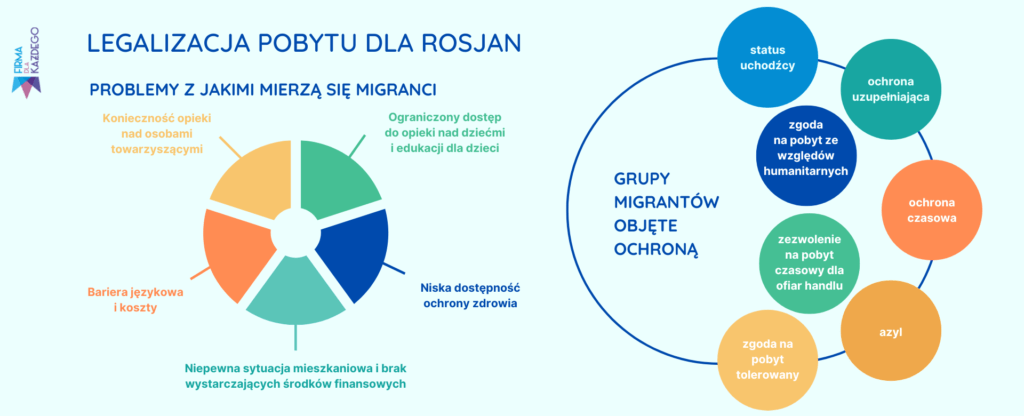
- Groups of foreign nationals covered by protection
- Can Russian citizens apply to work in Poland?
- What is a residence card?
Humanitarian visas for Russians in Western countries
The Ministry of Foreign Affairs has announced that Lithuania will consider each application for humanitarian visas for Russians on a case-by-case basis. The mobilisation of the armed forces announced by Putin may lead to a mass exodus of Russians to Western countries.
The individual assessment of applications for humanitarian visas is intended to safeguard Lithuania’s national security. At the same time, it leaves open the possibility of protection for persecuted members of civil society and the opposition. Lithuania wishes to avoid issuing visas to every Russian who submits such an application on humanitarian grounds.
Latvia’s Minister for Foreign Affairs, Edgaras Rinkevičius, has announced that his country will not grant asylum to Russian citizens evading mobilisation. Latvia will not make any changes to its stricter entry procedure for Russians. Effective from Monday 19 September 2022.
Border closed to Russians
The Lithuanian Foreign Minister, Gabrielius Landsbergis, stated that following the closure of the border to Russians by Lithuania, Latvia and Poland, the number of people attempting to cross the border has fallen significantly. Visa restrictions During the first week following the introduction of the visa restrictions, 356 Russian citizens were stopped at the border.
At present, Russians cannot enter Europe by land. The options for travelling by air via Istanbul are severely limited. This is because airlines and airports have their own capacity limits. Every day, tourists and business travellers travel by air.
The stricter procedures for issuing Schengen visas to Russian citizens meant that, during the first week:
- 153 people were refused entry to Lithuania;
- 48 were refused entry to Latvia;
- 155 were denied entry to Estonia.
This is according to findings by the Lithuanian border authorities. Some Russian citizens protested and refused to return to their home country.
Groups of foreign nationals entitled to protection
A foreign national may lawfully reside in Poland if they are covered by one of the following forms of protection:
- refugee status;
- subsidiary protection;
- temporary protection;
- asylum;
- permission to remain on humanitarian grounds;
- permission to remain on a tolerated basis;
- temporary residence permit for victims of trafficking;
- temporary residence permit on the grounds of respect for the right to family life and the rights of the child.
Once refugee status has been granted, the person is not required to obtain a work permit in Poland.
When can a Russian national work legally in Poland?
The above regulations also apply to Russian nationals who may be granted international protection. Poland has decided to abolish the special facilities for these foreign nationals regarding access to the labour market. Russians will no longer be granted seasonal work permits on preferential terms. Nor do they now qualify for the simplified procedure for declarations of entrusting work to a foreign national.
Nevertheless, since Putin announced the military mobilisation, there has been a very significant increase in the number of enquiries about work in Poland from Russians. Since 24 February, the total number of enquiries has been around 150. Currently, there are around 40 enquiries per day. This amounts to as many as 1,200 enquiries from Russians about work in Poland in a single month.

The next step is to abolish the requirement for residence permits for Russians who do not currently hold them.
In order to work in our country, a Russian citizen must meet the following conditions:
- hold a residence permit entitling them to work (visa, temporary residence permit);
- a work permit for Poland;
- a declaration of entrusting work to a foreigner, entered in the register of declarations;
- a seasonal work permit;
- a certificate confirming that the application for a seasonal work permit has been entered in the register of applications.
A brief summary
Russia’s invasion of Ukraine has led to numerous restrictions targeting citizens of the attacking country. This has resulted in the removal of facilitations regarding access to the Polish labour market and the granting of temporary residence permits. Tourist visas are also no longer issued to Russian citizens. Russians are not permitted to enter Poland via an external border for business, sporting, tourist or cultural purposes.
Are you a Russian citizen interested in business incubators or the legalisation of residence for Russians? Would you like to find out more? Get in touch with us!

Przedsiębiorca od prawie 20 lat. Związany m.in. z branżą inkubatorów przedsiębiorczości. Od ponad ośmiu zarządza Fundacją Firma Dla Każdego, która prowadzi jeden z największych inkubatorów w Polsce. Specjalizuje się w zagadnieniach prowadzenia i rozwoju biznesu, legalizacji pobytu i pracy, a także aspektami podatkowymi prowadzenia firmy.
Want to start a business without the paperwork?
Get in touch — we will help you choose the best way to run your business.
Get in touch