INFLUENCER – TAX RETURNS
09/05/2022
Influencer – the nature of the profession
Is being an influencer the profession of the future? The internet has a huge impact on politics, the economy and social life. It is impossible to completely isolate oneself from events online. Videos posted on YouTube or tweets from Twitter are quoted by the media and become part of national debates. It is therefore no surprise that what happens online is having an ever-greater impact on society as a whole.
Research shows that the dream of Polish teenage girls aged 10–15 is to become a YouTuber, an Instagrammer or a TikToker. Experts acknowledge that young people lack role models, which is why they turn to the internet so readily. There, they can see young adults slightly older than themselves who, whilst leading interesting lives, are also able to earn a living from it. In Poland, there will be an increasing number of influencers who treat their activity as a fully-fledged profession. So, if we choose to pursue influencing as a source of income, it is also worth regulating this profession in legal and economic terms and paying tax on our online activities. And what’s the best way to go about this?
Who is an influencer?
An influencer is a person who, through their online activity, exerts a significant influence on others. They are usually a young adult who runs a profile on one of the popular social media platforms and, thanks to their activities, has gained a large following. Various brands are very keen to collaborate with such individuals, basing their partnerships, for example, on product placement. Ideally, the product should be versatile enough to look very natural in the influencer’s advert or to fit in with their usual content. An example would be a beauty influencer testing cosmetics recommended by a sponsor. Thanks to their reach, personality and the way they present the product, influencers can have a significant impact on how a product is perceived, its sales or changes to its image. Brands aimed at young people are by far the most popular amongst online ‘idols’.
What opportunities does working online offer?
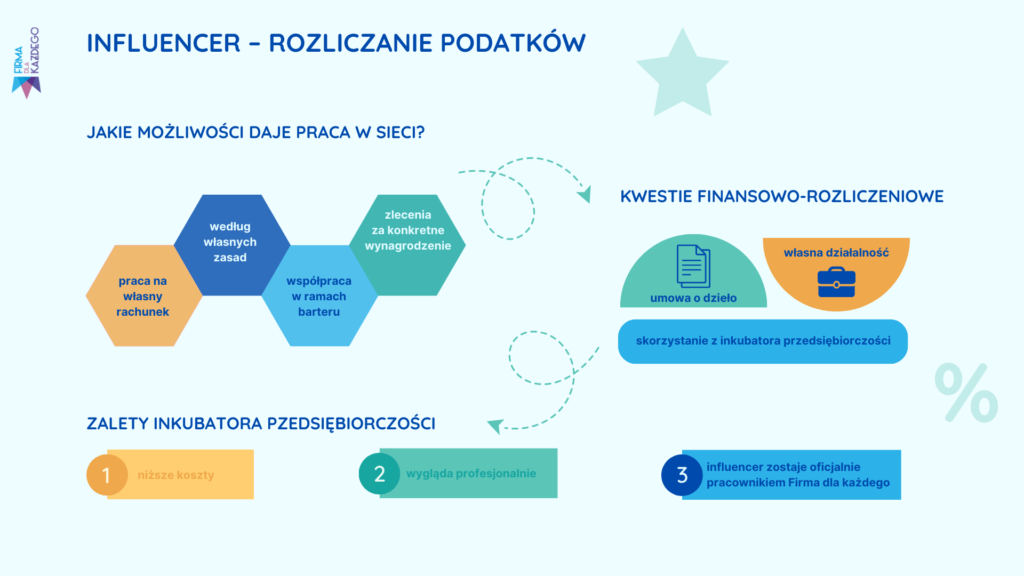
Working online seems to be very attractive. Above all, the prospect of being self-employed and working on one’s own terms is particularly appealing to young people. An influencer decides for themselves when and how they work; however, it must be admitted that gaining popularity is by no means as easy as it might seem. The fact is that only the best make it through, and only they stand a chance of securing the best contracts. Beginner influencers often start by collaborating on a barter basis – they receive cosmetics and are tasked with promoting them. In return for their efforts, they receive the product in question. This allows them to save money on purchases such as clothes or groceries, whilst continuing to expand their reach and build partnerships with brands. Over time, however, they start receiving commissions based on a fixed fee. How should an influencer account for their income from online activities?

Financial and tax matters
Any income we earn is subject to tax. This is particularly true if the work can be easily verified. Consequently, the tax authorities are keeping a closer eye on influencers’ activities. There is no problem if, as part of the work, you sign a contract for specific work with the client. In that case, tax will be paid and the influencer can safely accept payment for their services. However, signing contracts for specific work can become problematic and burdensome over time. A potential client will not always be willing to pay additional taxes on the influencer’s behalf. The services of people who run their own business and can issue invoices for promoting products online certainly look far more professional. This, however, involves setting up your own business and incurring monthly costs, which are not insignificant, particularly for young people. So what is the best way for budding influencers to sort out the formalities?
How can you stay ‘in the clear’ with the tax authorities?
An influencer can, of course, set up their own business, which involves costs. They can also sign a contract for specific work with each client, though this can be a hassle. A good solution is to make use of so-called business incubators – companies that lend their legal status and take young people who are just starting their careers under their wing. The ‘Firma Dla Każdego’ Foundation enables you to settle payments directly with the incubator on the basis of a contract for specific work. This is a convenient solution – being represented by the Foundation in dealings with the client looks professional. Furthermore, it results in significantly lower costs than in other scenarios (running your own business, signing a contract for specific work on a case-by-case basis). An influencer who enters into a partnership with the Foundation is officially its employee. As a result, their activities will not raise any objections from the tax office or other authorities.
See also: Social security contributions in a company

Przedsiębiorca od prawie 20 lat. Związany m.in. z branżą inkubatorów przedsiębiorczości. Od ponad ośmiu zarządza Fundacją Firma Dla Każdego, która prowadzi jeden z największych inkubatorów w Polsce. Specjalizuje się w zagadnieniach prowadzenia i rozwoju biznesu, legalizacji pobytu i pracy, a także aspektami podatkowymi prowadzenia firmy.
Want to start a business without the paperwork?
Get in touch — we will help you choose the best way to run your business.
Get in touch