HOW DO YOU RUN A BUSINESS UNDER THE FLAT-RATE SCHEME?
21/07/2023
Although the law permits various forms of taxation on income from business activities, in reality many business owners have no idea how to run a business under the flat-rate scheme. Meanwhile, for many business owners, the flat-rate scheme is an excellent way to optimise their tax liability. What does the flat-rate scheme involve, how do you set up a business under this scheme, and what should you bear in mind when running a business under the flat-rate scheme? Find out below!
Forms of taxation on business income
Every entrepreneur faces the challenge of choosing the right form of taxation for business income. The basic and, at the same time, most popular form of taxation for business income is the general system, i.e. the tax scale. Under this system, income up to the first tax threshold – i.e. PLN 120,000 – is taxed at 12 per cent, and at 32 per cent once that threshold is exceeded. The second option is to tax income at a flat rate of 19 per cent. The third option is to tax income under the flat-rate scheme based on recorded revenue, which is often overlooked by business owners.
Rules for running a business under the lump-sum scheme
The rules for running a business under the flat-rate scheme are fairly straightforward. The flat-rate scheme is a simplified form of taxation on income derived from business activities. It involves taxing income at fixed rates ranging from 2 to 17 per cent, with the choice of rate depending on the type of business activity carried out. How do you run a business under the lump-sum scheme? Entrepreneurs determine the amount of the lump-sum payment for each month themselves and pay it by the 20th of the following month; for December, payment is due by the end of January. There is also the option of quarterly settlements. How do you set up a business under the flat-rate scheme? All you need to do is submit a declaration opting for flat-rate taxation to the relevant tax office or via the CEIDG.
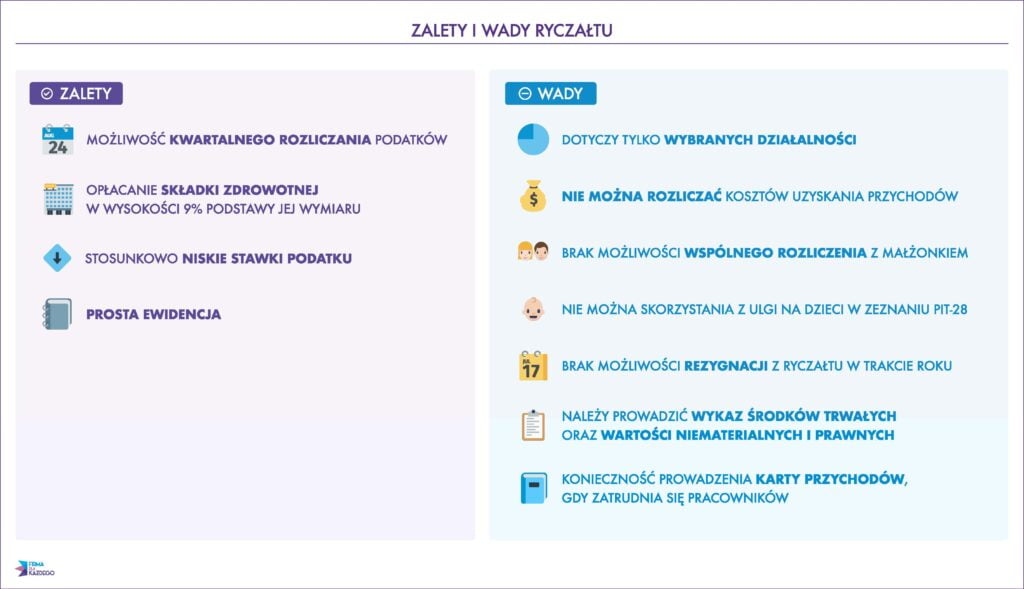
Who can opt for the flat-rate scheme and who cannot?
The law sets out two conditions that must be met for an entrepreneur to be able to tax their income under the flat-rate scheme. Firstly, in accordance with the law, a sole trader, an inherited business and a civil law partnership may be taxed under the flat-rate scheme if the sole partners are natural persons; or an inherited business and a general partnership may be taxed under the flat-rate scheme if the sole partners are natural persons. Secondly, an entrepreneur may opt for the flat-rate scheme if their revenue in the previous tax year did not exceed the limit of 2 million euros, calculated at the average euro exchange rate published by the National Bank of Poland (NBP) on the first working day of October of the previous year. Further regulations in this regard are available at https://www.biznes.gov.pl/pl/portal/00263#1.
Self-employment, the flat-rate scheme and income records
A problem faced by business owners is a lack of knowledge about how to run a business under the flat-rate scheme and what the rules are regarding record-keeping. However, these rules are straightforward – business owners operating under the flat-rate scheme use simplified accounting. By law, income records under the flat-rate scheme should be kept in accordance with the template set out in the Regulation of the Minister of Finance of 17 December 2021 on the keeping of income records and the register of fixed assets and intangible assets.
Tax rates under the flat-rate scheme
For example, the highest rate applies to income from the liberal professions, the 15 per cent rate applies to income from wholesale agency services, whilst the 14 per cent rate applies to income from architectural and engineering services, technical research and analysis, healthcare and specialist design services. In turn, the 12.5 per cent rate covers, amongst other things, income from consultancy services relating to computer equipment, whilst the 10 per cent rate applies to revenue from services involving the purchase and sale of property on one’s own account. Meanwhile, the 8.5 per cent rate applies to revenue up to PLN 100,000 and the 12.5 per cent rate applies to revenue in excess of PLN 100,000; this covers, amongst other things, income from accommodation-related services. A rate of 5.5 per cent applies to income from manufacturing activities, construction works or the carriage of goods by motor vehicles with a load capacity exceeding 2 tonnes, whilst a rate of 3 per cent applies to – includes income from, amongst other things, catering activities, with the exception of revenue from the sale of beverages with an alcohol content exceeding 1.5 per cent.

Przedsiębiorca od prawie 20 lat. Związany m.in. z branżą inkubatorów przedsiębiorczości. Od ponad ośmiu zarządza Fundacją Firma Dla Każdego, która prowadzi jeden z największych inkubatorów w Polsce. Specjalizuje się w zagadnieniach prowadzenia i rozwoju biznesu, legalizacji pobytu i pracy, a także aspektami podatkowymi prowadzenia firmy.
Want to start a business without the paperwork?
Get in touch — we will help you choose the best way to run your business.
Get in touch