BUSINESS PLAN – PROS AND CONS
24/04/2022
A business plan – is it worth having one?
A good business plan should form the basis of any business venture. Starting a business is usually preceded by lengthy deliberation, analysis and seeking the opinions of others, in order to get off to the best possible start and prepare for operating in the market. You can draw up a business plan in your head, but you can also prepare a written document on paper or as a digital file.
However, a business plan should contain certain key elements on which you’ll base your entire business. A business plan that is as detailed as possible allows you, right from the planning stage, to identify potential opportunities and threats, and to prepare a suitable action plan in advance. Find out how to create a useful business plan that you can utilise in many different ways.
Why create one?
A business idea alone is usually not enough. To achieve success, it is better to define all the stages of your business, how to implement them, potential sources of funding and many other factors. Ideas, even if they are good, tend to vanish quickly or remain merely as concepts that will need to be tested against market realities. It is a good idea to start writing your business plan as soon as possible, as this document can be quite extensive and working on it can take a lot of time. However, many people regard this stage as essential for being able to work effectively and systematically later on. A business plan usually contains short-term and long-term objectives, which should be organised and set out in an appropriate timetable. Organising your idea in this way will enable you to implement each stage and also prevent setbacks at an early stage.
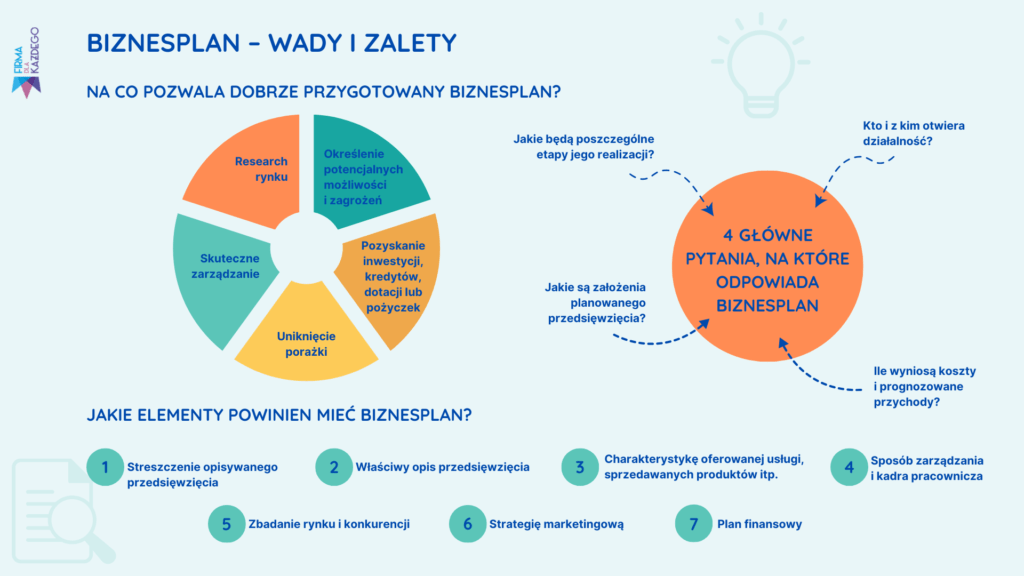
What does a well-prepared business plan enable?
- Market research – gathering the necessary information on the structure of the sector you intend to enter, competitors’ activities, currently used solutions, etc.
- Identifying potential opportunities and threats – before starting your business, it is advisable to carry out a SWOT analysis, which comprises four pillars: strengths and weaknesses, as well as opportunities and threats arising from market conditions and the nature of the business you are launching.
- Securing investment, credit, grants or loans – most financial institutions from which you intend to seek financial support require a business plan.
- Effective management – a business plan will help you focus on your objectives and work towards achieving them. This will certainly make running your business easier, particularly in the early stages.
- Avoiding failure – even the most innovative start-up may struggle without a well-prepared plan.
A business plan is often a key element when applying for funding to set up a business. The more thoroughly it is drawn up, the greater the chances of receiving a positive decision.

How do you create one?
Writing a business plan certainly won’t be a job that can be completed in just one or two days. It is just as important a task as all the other steps involved in launching a new business, such as seeking out potential investors. A business plan is usually drawn up before the business is even launched, or at the time of restructuring, or during periods of significant change. A good business plan should, above all, be factual, without unnecessary ‘fluff’ or embellishments. However, there isn’t really a single template for what this type of document should look like. A business plan prepared for your own needs looks different from one submitted to a specific institution for a particular purpose.
What elements should a business plan contain?
A business plan primarily answers four key questions:
- Who is setting up the business and with whom?
- What are the objectives of the planned venture?
- What will the individual stages of its implementation be?
- What will the costs and projected revenues be?
The document should have a table of contents and a clear, well-organised structure so that it is easy to read. In addition, it is advisable to use professional yet accessible language. Most business plans follow a similar structure, comprising:
- A summary of the project (the summary can be written at the end after extracting all the key elements from the individual sections),
- A detailed description of the venture (basic information about the company, such as: name, purpose, location and place of operation, type of business, etc.),
- A description of the services offered, products sold, etc. (specifying what the company will do, and in what ways its services or products will be innovative compared to others),
- Management structure and staff (outlining the company’s organisational structure and the responsibilities of individual staff members for specific areas),
- Market and competitor analysis (characteristics of the industry and competitors, market trends and forecasts, potential customers),
- Marketing strategy (promotional methods, market launch, distribution channels, forms of promotion and advertising),
- Financial plan (operating costs, sources of funding)
If you have any further questions, please do not hesitate to contact us.

Przedsiębiorca od prawie 20 lat. Związany m.in. z branżą inkubatorów przedsiębiorczości. Od ponad ośmiu zarządza Fundacją Firma Dla Każdego, która prowadzi jeden z największych inkubatorów w Polsce. Specjalizuje się w zagadnieniach prowadzenia i rozwoju biznesu, legalizacji pobytu i pracy, a także aspektami podatkowymi prowadzenia firmy.
Want to start a business without the paperwork?
Get in touch — we will help you choose the best way to run your business.
Get in touch