WHAT TAX REGIME APPLIES TO A SOLE TRADER?
30/07/2023
Running your own business involves paying tax on your income. Which form of taxation is best for a sole trader? It depends. Primarily, it depends on the type of business you run, the revenue you generate and the expenses you incur. Of course, how much tax a sole trader pays also depends on the form of taxation. If you read the text below, you’ll find out which form of taxation is best for the sole trader business you run.
Taxation of sole traders – What do you need to know?
Under current legislation, income derived from business activities is subject to compulsory personal income tax (PIT), as set out in the Personal Income Tax Act <Act of 26 July 1991 on personal income tax (Journal of Laws 2020.0.1426, consolidated text)>). Every sole trader is subject to tax; the taxes they will pay, and more specifically, the amount of those taxes, depend to a large extent on the form of income taxation chosen by the entrepreneur. This is because a sole trader’s income, expenses and method of taxation determine how much tax the sole trader pays.
What forms of taxation are available for sole traders?
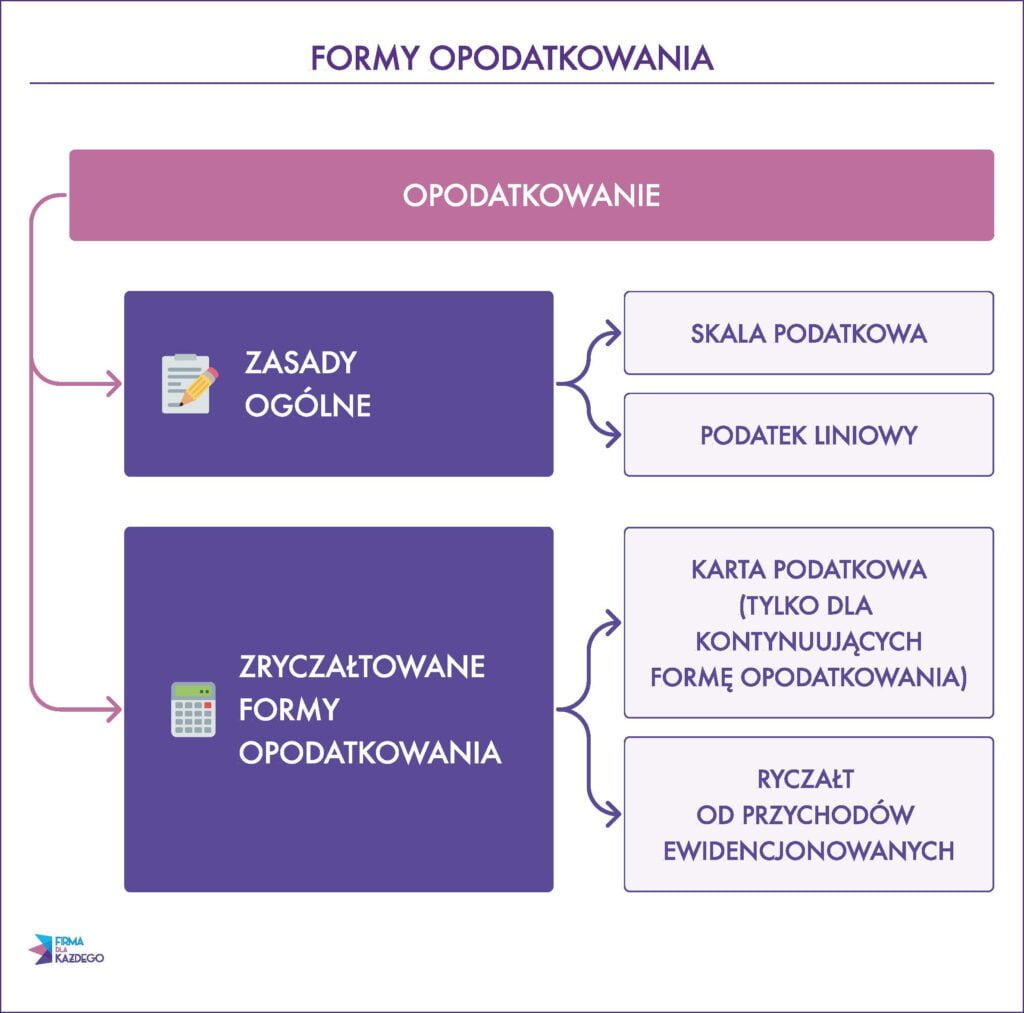
The law allows entrepreneurs to choose the form of income taxation. The choice of a particular option affects how much tax a sole trader pays. Therefore, an entrepreneur should carefully consider which form of taxation is optimal for the sole trader business they run. An entrepreneur may opt for:
- the tax scale,
- a flat-rate tax,
- a flat-rate tax on recorded income.
In previous years, in addition to the forms mentioned above, entrepreneurs could settle their income using a tax card. However, since last year, this form of taxation has only been available to those taxpayers who continue to be taxed via the tax card system – that is, only those entrepreneurs who were already taxed in this way in 2021.
The choice of taxation method should by no means be arbitrary. Therefore, an entrepreneur’s decision on which taxation method is best for a sole trader business should be preceded by a thorough analysis of the advantages and disadvantages of each option.
Which form of taxation is best for a sole trader – general principles?
The tax scale and the flat-rate tax are forms of taxation under the general rules. The tax scale is the most popular form of income taxation for sole traders in Poland. Under this system, the business owner pays income tax at a rate of 12 per cent on income up to PLN 120,000, and 32 per cent on the amount exceeding the first tax threshold. The flat-rate tax, on the other hand, involves taxing all income at the same rate, namely 19 per cent. It is worth noting that the health insurance contribution under the general rules amounts to 9 per cent of the income from the month preceding the month in which the tax return is filed, whilst for the flat-rate tax it is 4.9 per cent. The tax scale is the best form of taxation for a sole trader who earns a lower income, claims tax reliefs, or files a tax return with a child or jointly with a spouse who earns a lower income. Conversely, the flat-rate tax will be more attractive to businesses generating high income; in other words, it is the best form of taxation for a sole trader whose income exceeds the first tax threshold.
Advantages and disadvantages of the flat-rate tax on recorded income
The flat-rate tax on recorded income is a less popular method of taxing a sole trader, although for some entrepreneurs considering which tax regime to choose for their sole trader business, it would certainly be a favourable option. Why might the flat-rate tax on recorded income be the best form of taxation for a sole trader? First and foremost, because it is a simplified form of tax on business income, with tax rates ranging from 2 to 17 per cent. The main advantages of this scheme include simple documentation, reduced record-keeping requirements for revenue, and no need for monthly tax returns. Another obvious advantage is the low health insurance contribution, which amounts to 9 per cent of the assessment base. On the other hand, the disadvantages of this form of taxation for a sole trader include the inability to claim most tax reliefs and to file a joint tax return with a spouse, as well as the need to prepare a physical inventory. Importantly, not every business can be taxed in this way.
Optimisation – which form of taxation for a sole trader?
The tax charged to a sole trader depends on which form of taxation the entrepreneur chooses for their business. Nevertheless, it is not possible to definitively state which form of taxation is best for a sole trader. The entrepreneur must optimise costs and regularly assess which form of taxation on their income is most advantageous for them. To this end, they should seek the services of an experienced accountancy firm and other specialists in this field.

Przedsiębiorca od prawie 20 lat. Związany m.in. z branżą inkubatorów przedsiębiorczości. Od ponad ośmiu zarządza Fundacją Firma Dla Każdego, która prowadzi jeden z największych inkubatorów w Polsce. Specjalizuje się w zagadnieniach prowadzenia i rozwoju biznesu, legalizacji pobytu i pracy, a także aspektami podatkowymi prowadzenia firmy.
Want to start a business without the paperwork?
Get in touch — we will help you choose the best way to run your business.
Get in touch