LEGAL FORMS OF BUSINESS OPERATION – PROS AND CONS
01/04/2023
There are several forms of business organisation in Poland. The differences between them relate to the formalities that must be met and to financial matters. Find out which legal forms of business organisation are available and lawful in Poland.
What is important when choosing a business structure?
The key differences when it comes to business structures are:
- running a business on your own or with a partner;
- liability for obligations incurred;
- the type of taxation and the method of bookkeeping;
- the minimum capital required to set up a business;
- how the business is represented in official matters;
- the place where you can register your business and complete the remaining formalities.
Basic forms of business organisation
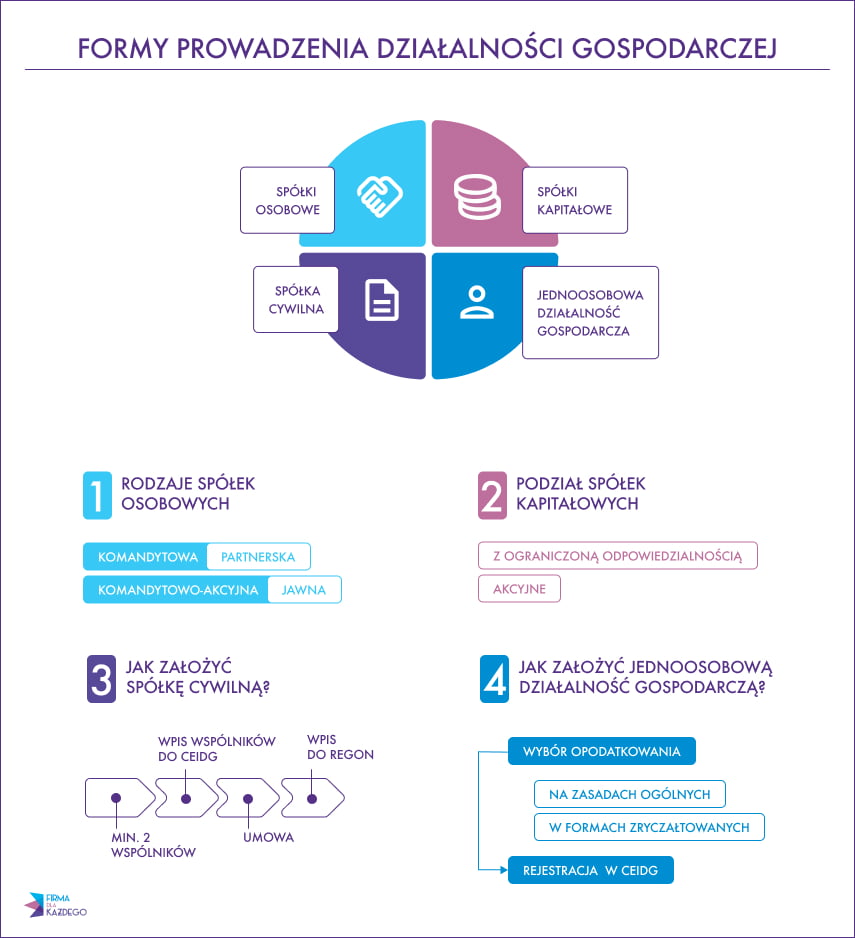
The possible forms of business organisation in Poland are:
- a sole trader;
- a civil law partnership;
- capital companies: a limited liability company and a public limited company;
- partnerships: general partnership, professional partnership, limited partnership and limited partnership with share capital.
Below, we will discuss the most popular forms of business organisation in Poland. A sole trader is the most common, so we will devote the most space to it.
Forms of business organisation – sole trader
It can only be set up by a natural person. The name must include the first name and surname of the business owner. Information about the business’s specific activities may also be included. Registration with the Central Register and Information on Economic Activity (CEIDG) is required. However, there is no need to sign a contract or draw up articles of association.
A business in this form is not a legal entity with its own rights and obligations and does not carry out legal acts in its own name. This is done by the business owner. A sole trader business requires no financial outlay and has no official governing bodies. The owner acts as the business’s representative. The owner also makes all decisions relating to the running of the sole trader business. The owner is liable for the business’s obligations with all their assets.

Possible forms of taxation include:
- taxation under general rules: according to the tax scale at 12% or 32%, or a flat rate of 19%
- flat-rate taxation: a lump sum on recorded income or a tax card (provided that certain criteria are met).
The entrepreneur is required to keep simplified accounts until their revenue exceeds the statutory limit of 2 million euros. At that point, they switch to full accounting. They are obliged to pay social security contributions (ZUS) for themselves and their employees.
A civil law partnership – another form of business organisation in Poland
A minimum of two partners is required to set one up. These may be natural persons, legal persons or organisational units with legal capacity. The name of a civil law partnership should include the first names and surnames, the full or abbreviated business name, and the addresses of the partners, together with the designation ‘civil law partnership’ or ‘s.c.’. An agreement must be signed to establish it. Each partner must register with CEDiG. In addition, the civil partnership must be entered in the REGON register. It has no official governing bodies. All partners are jointly and severally liable for the partnership’s obligations.
General partnership
A minimum of two partners is required to set one up. These may be natural persons, legal persons or organisational units with legal capacity. The name should include the surname of one of the partners or the full company name. It is also required that the name ends with the designation ‘general partnership’ or ‘sp. j.’. It is also necessary to sign a partnership agreement. This should take the form of a notarial deed if a partner’s contribution consists of immovable property. A general partnership is entered in the National Court Register (KRS).
Professional partnership – what sets it apart?
It can be set up by at least two people who are authorised to practise a liberal profession. The name of a partnership must include the surname of at least one of the partners. The requirements regarding agreements are identical to those for a general partnership. It is also registered with the National Court Register (KRS). A professional partnership does not have legal personality. However, it may acquire rights (including ownership), incur liabilities, sue and be sued. It is not required to have official governing bodies, but it may appoint a management board.

Limited liability company
It may be founded by a natural person, a legal person or an organisational unit with legal capacity. The company’s name must include the words ‘limited liability company’ or ‘sp. z o.o.’ or ‘sp. z o.o.’. A limited liability company is established on the basis of a deed drawn up by a notary public. Where the founder is a single person, a memorandum of association is signed.
Remember to always choose a business structure that suits your needs and the specific nature of your industry.

Przedsiębiorca od prawie 20 lat. Związany m.in. z branżą inkubatorów przedsiębiorczości. Od ponad ośmiu zarządza Fundacją Firma Dla Każdego, która prowadzi jeden z największych inkubatorów w Polsce. Specjalizuje się w zagadnieniach prowadzenia i rozwoju biznesu, legalizacji pobytu i pracy, a także aspektami podatkowymi prowadzenia firmy.
Want to start a business without the paperwork?
Get in touch — we will help you choose the best way to run your business.
Get in touch