How do you wind up a sole trader business?
22/09/2024
Closing down a business involves a number of obligations that must be fulfilled in order to formally wind up the company. It is therefore not enough simply to stop providing services or selling goods. In this article, we describe, step by step, how to wind up a sole trader business.
Winding up a sole trader business step by step: deregistration from the CEIDG
To formally cease trading, you must first submit an application to have your sole trader business removed from the Central Register and Information System on Economic Activity (CEIDG).
Although the legislation does not specify a deadline by which you must do this, it is advisable to deal with it as soon as possible. This will enable you to deregister as a contributor to the Social Insurance Institution (ZUS).
So how do you apply to be removed from the CEIDG?
- Online via the Entrepreneur’s Account on the Central Register and Information on Economic Activity website (the process here is similar to that for suspending a sole trader business);
- In person at the local council or town hall (if you choose this option, remember to bring your ID with you);
- By post, i.e. by sending the form by post to the address of the local authority (if you choose this option, however, you must have your signature on the application notarised).
Deletion from the CEIDG takes place no later than the next working day after:
- The date on which the application was sent electronically;
- The date on which the application is submitted in person at the office;
- The date on which an application sent by post is received by the office.
Step-by-step guide to winding up a sole trader business: deregistration from ZUS
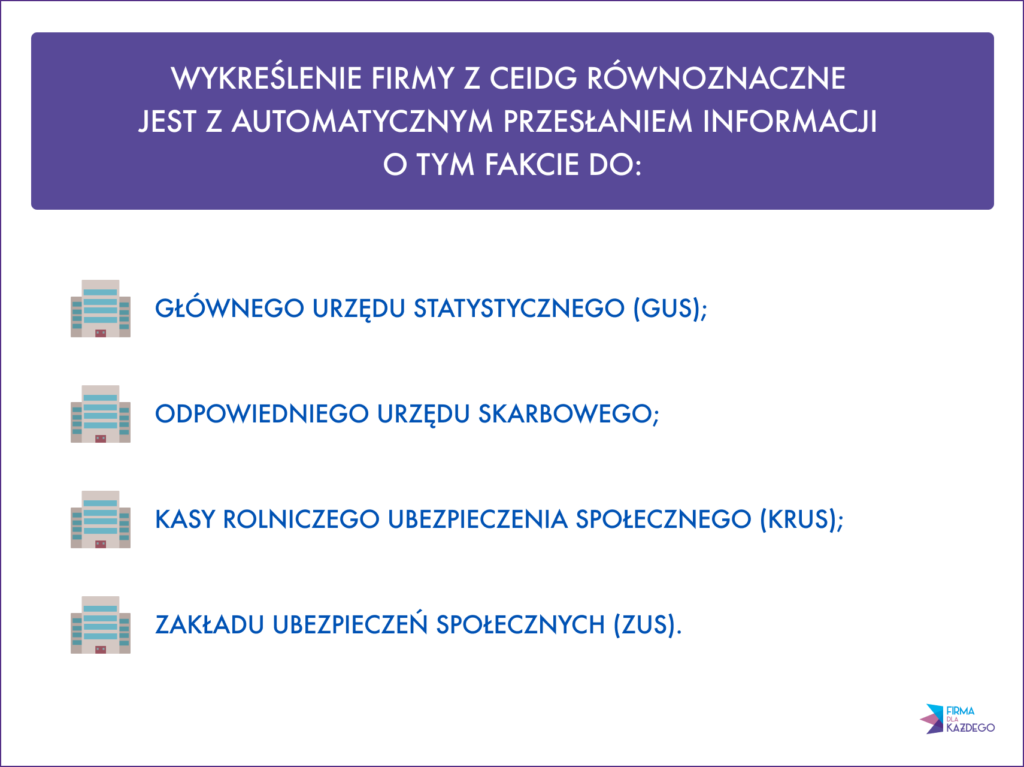
Deregistration of a business from the CEIDG automatically triggers the forwarding of this information to:
- The Central Statistical Office (GUS);
- The relevant tax office;
- the Agricultural Social Insurance Fund (KRUS);
- the Social Insurance Institution (ZUS).
All these institutions are therefore aware that we have decided to cease trading. In the case of ZUS, this means that we will be automatically deregistered as contributors.
However, we are still obliged to deregister ourselves and any other people we have registered for insurance (i.e. business partners and family members). We will do this by using:
- The ZUS ZWUA form, which is used to deregister self-employed persons and their associates from the insurance scheme;
- The ZUS ZCNA form, which allows us to deregister family members (both our own and those of our employees).
The easiest way is to attach these forms directly to the application for removal from the CEIDG. In this case, the CEIDG will forward them to ZUS.
However, we can also submit them ourselves, directly to ZUS, either electronically or on paper, within 7 days of the date on which the insurance obligation ceases.
Winding up a sole trader business step by step: other obligations
Remember that submitting an application to have your business removed from the CEIDG and deregistering from social security with ZUS is not the end of the process!
Once you have ceased trading, you must also:
- Pay social security contributions for the month in which you closed your business (calculating the amount proportionally to the period of operation);
- Pay your final health insurance contribution (in full), which will allow you to continue to benefit from health insurance for a further 30 days from the date of ceasing business activity;
- Draw up a list of the business’s assets (which must be kept for the next 5 years);
- Draw up a physical inventory as at the date of ceasing business operations (this requirement applies only to businesses keeping a tax-based income and expenditure ledger);
- Pay income tax for the final month of business operations (in accordance with the existing rules in the case of taxation under the tax scale, the flat-rate tax or the lump-sum tax on recorded income, or at a rate of 1/30 of the monthly liability for each day up to the date of ceasing business operations in the case of taxation under the tax card scheme);
- Notify the tax office of the cessation of activities subject to VAT within 7 days of the date of ceasing business operations using the VAT-Z form (this obligation applies to VAT payers);
- Carry out a physical inventory for VAT purposes and, in the form of a return (JPK_V7M or JPK_V7K), declare the VAT amount resulting from this inventory (this obligation also applies exclusively to VAT payers);
- Deregister the cash register (if you used one in the course of your business);
- Terminate contracts with employees;
- Submit your annual tax return;
- Retain the documentation of the wound-up business for the period required by law.
Are you thinking about how to wind up a sole trader business?
Are you considering giving up your business? We know that the reasons may include, amongst other things, excessive costs or a lot of red tape.
The solution to these, as well as other problems associated with running your own business, could be Poland’s best business incubator from the Firma Dla Każdego Foundation!
You can find details of our offer on the website: https://firmadlakazdego.pl/.
Sources:
- https://www.biznes.gov.pl/pl/portal/0077
- https://firmadlakazdego.pl/wysokosc-skladek-zus-dla-prowadzacych-dzialalnosc-gospodarcza/
- https://firmadlakazdego.pl/koszty-firmy-jednoosobowej-w-2023-roku-jak-wysokie-beda/
- https://firmadlakazdego.pl/czym-jest-inkubator-przedsiebiorczosci/
- https://firmadlakazdego.pl/

Przedsiębiorca od prawie 20 lat. Związany m.in. z branżą inkubatorów przedsiębiorczości. Od ponad ośmiu zarządza Fundacją Firma Dla Każdego, która prowadzi jeden z największych inkubatorów w Polsce. Specjalizuje się w zagadnieniach prowadzenia i rozwoju biznesu, legalizacji pobytu i pracy, a także aspektami podatkowymi prowadzenia firmy.
Want to start a business without the paperwork?
Get in touch — we will help you choose the best way to run your business.
Get in touch